One-Second Clock Circuit: Build Your Precise Timing System
Description
This accurate one-pulse-per-second clock is constructed using several readily available components and powered from a 50 or 60 Hertz alternating current supply without a direct connection to it. A discernible beep or metronome-like sound and/or a visible flash will mark the one-second interval, which can be beneficial in diverse applications requiring time-delay counting in seconds. The circuit is formed by a CMOS 4024 counter/divider integrated circuit and three diodes, configured to divide the frequency of the input signal at pin #1 by 50 (or 60, see Notes).
The input impedance at pin #1 is exceptionally high; therefore, merely touching the pin (or a brief track or piece of wire connected to it) is typically sufficient to provide the necessary input signal. Alternatively, an input signal can be supplied by a piece of wire wrapped multiple times around a convenient mains cable or transformer. No further connection is required.
Circuit diagram:
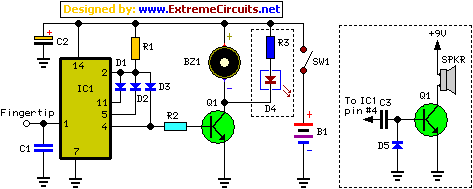
Parts:
- R1 = 10K
- R2 = 47.K
- R3 = 100R
- C1 = 1nF-63V
- C2 = 10µF-25V
- C3 = 100nF-63V
- D1 = 1N4148
- D2 = 1N4148
- D3 = 1N4148
- D4 = LED-(Optional, any shape and color, see Notes)
- D5 = 1N4148-75V 150mA Diode (Optional, see Notes)
- Q1 = BC337-45V 800mA NPN Transistor
- IC1 = 4024-7 stage ripple counter IC
- BZ1 = Piezo sounder (incorporating 3KHz oscillator)
- SPKR = 8 Ohm, 40 - 50mm diameter Loudspeaker (Optional, see Notes)
- SW1 = SPST Toggle or Slide Switch (Optional, see Notes)
- B1 = 3 to 12V Battery (See Notes)
Notes:
- To achieve precise circuit operation in environments where the mains supply frequency is rated at 60Hz, the circuit must be modified as follows: disconnect the Cathode of D1 from pin #11 of IC1 and connect it to pin #9. Add a further 1N4148 diode, connecting its Anode to R1 and the Cathode to pin #6 of IC1: that’s all!
- The circuit will function correctly with battery voltages ranging from 3 to 12V.
- The visual display, formed by D4 and R3 is optional. Please note that R3 value shown in the Parts list is suited to low battery voltages. If 9V or higher voltages are used, change its value to 1K.
- If a metronome-like click is desired, R2 and BZ1 must be omitted and replaced by the circuit shown enclosed in dashed lines, right-side of the diagram.
- Stand-by current drawing is negligible, so SW1 can be omitted.