DIY Continuity Tester: Build Your Precision Circuit
Circuit diagram:
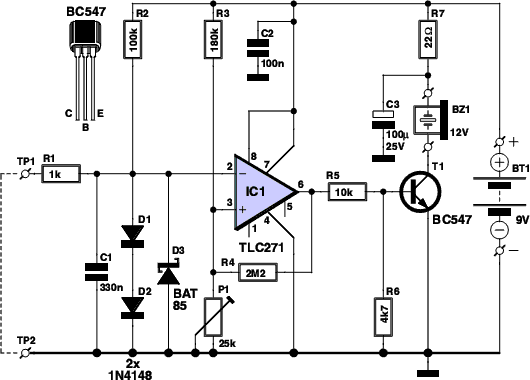
It is important to maintain good connections – not only in daily life, but also in electronics. Unlike social connections, the reliability of electrical connections can be quickly and easily verified. Various types of continuity testers are commercially available for this purpose. Most multimeters also have a continuity test function for electrical connections. A simple beep helps to distinguish between good and bad connections.
However, in some cases the tester doesn’t produce a beep because it won't accept contact resistances that are somewhat higher than usual. Also, poorly conducting (and thus bad) connections are sometimes indicated to be good. Here e-trix offers a design for a DIY continuity tester that helps to separate the desirable from the undesirable.
Circuit description:
Many multimeters possess a built-in continuity test function. However, in numerous instances, the resistance required to activate the beeper when searching for faulty connections is just a little too high. It can also occur that the beeper sounds even though the resistance of the connection is unacceptably high. This circuit enables you to adjust the threshold between good and bad connections to meet your specific requirements. The circuit is based on an operational amplifier (IC1) configured as a comparator.
The opamp compares the voltage on its inverting input (pin 2) with the voltage on its non-inverting input (pin 3). The voltage on pin 3 can be set using potentiometer P1, so you can set the threshold between good and bad connections. When test probes TP1 and TP2 are placed on either side of a connection or contact to be tested, a voltage is generated across the probes by the current flowing through resistors R1 and R3, and it appears on pin 2 of the opamp. This voltage depends on the resistance between the probe tips.
If the voltage on pin 2 is lower than the reference voltage on pin 3, the difference is amplified so strongly by the opamp that its output (pin 6) is practically the same as the supply voltage. This causes transistor T1 to conduct, which in turn causes DC buzzer BZ1 to sound. This means that the resistance of the connection being tested is less than the threshold value set by P1, and thus that the connection is OK.
By contrast, a bad connection will cause the relationship between the voltages on the inputs of the opamp to be the opposite, with the result that its output will be at ground level. The transistor will not conduct, and the buzzer will remain silent. To ensure that the opamp ‘toggles’ properly (which means that its output goes to ground level or the supply voltage level) when the difference voltage is sufficiently large and does not oscillate during the transition interval due to small fluctuations in the difference voltage produced by interference, its output is coupled back to its non-inverting input (pin 3) by resistor R4.
This causes any change on the output to be passed back to this input in amplified form, with the result that the detected difference voltage is amplified (and thus boosted). Diodes D1, D2 and D3 protect the circuit against excessive positive and negative input voltages that may come from the connections or contacts being tested. They also ensure that the continuity tester does not inject excessively high voltages into the item under test. Capacitor C1 suppresses high-frequency interference. The circuit draws only a small supply current, so it can easily be powered by a 9-V battery.
Operational Amplifier (IC1)
The operational amplifier (IC1) within this continuity tester serves as the core comparator. It's a versatile integrated circuit that’s frequently used in analog circuits for amplifying and comparing voltages. In this specific design, IC1 is configured as a comparator, enabling it to compare two input voltages and output a signal indicating which voltage is higher. This capability is crucial for determining whether the resistance between the test probes is within the acceptable range. The opamp typically features high input impedance, low offset voltage, and high gain, contributing to the accuracy and reliability of the continuity tester.
Transistor (T1)
Transistor T1 is a key component in this continuity tester, acting as a switch controlled by the operational amplifier (IC1). When the opamp's output is at a high voltage, T1 conducts, allowing current to flow through the DC buzzer (BZ1), producing the audible beep. Conversely, when the opamp's output is at ground level, T1 is off, and the buzzer remains silent. The transistor facilitates the switching action, providing a reliable way to control the buzzer's state based on the comparator's output.
DC Buzzer (BZ1)
The DC buzzer (BZ1) is an audible indicator within the continuity tester. It emits a sound when the transistor (T1) is conducting, signaling that the resistance between the test probes is within the acceptable range. The buzzer's operation is directly controlled by the transistor, acting as a switch to enable or disable the audio output. It offers a clear and distinct indication of whether a connection is good or bad.
circuit from http://www.extremecircuits.net/2010/04/continuity-tester-circuit-diagram.html