High Voltage Defender: 200-400V Shock!
Circuit diagram:
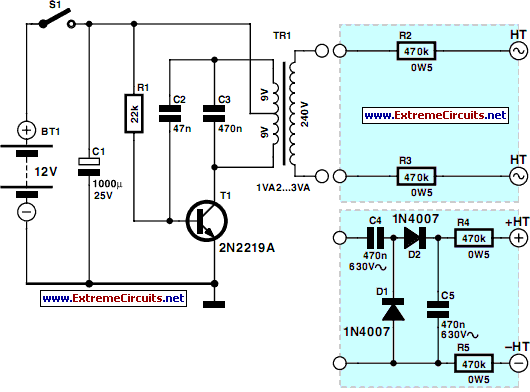
Description
Here’s a project that could be useful this summer on the beach, to deter anyone from touching your belongings left on your beach towel while you’ve gone swimming; you might equally well use it at the office or workshop when you return to work. In a very small space, and powered by simple primary cells or rechargeable batteries, the proposed circuit generates a low-energy, high voltage, in the order of approximately 200 to 400 V, harmless to humans, of course, but still capable of delivering a rather unpleasant ‘shock’ to anyone who inadvertently touches it.
Aside from this practical application, this project will also prove instructive for younger hobbyists, allowing them to discover a circuit that many older enthusiasts who worked in radio, and who particularly enjoyed valve technology, are sure to be familiar with. As the circuit diagram illustrates, the project is remarkably simple, containing only a single active element – a transistor. As shown here, it operates as a low-frequency oscillator, permitting the conversion of the battery’s DC voltage into an AC voltage that can then be stepped up via a transformer.
Utilizing a centre-tapped transformer, as depicted here, makes it possible to construct a ‘Hartley’ oscillator around transistor T1, which, as previously indicated, was extensively used in radio during the era when valves dominated and the transition to silicon electronics was yet to commence. The ‘Hartley’ is one of a number of L-C oscillator designs that achieved lasting fame and was named after its inventor, Ralph V.L Hartley (1888-1970). For such an oscillator to function correctly and produce a genuine sine-wave output, the position of the intermediate tap on the winding had to be carefully selected to ensure the correct voltage reduction ratio.
In this instance, the voltage reduction is achieved inductively. Here, optimal inductive tapping is not feasible because we’re using a standard, commercially available transformer. However, we’re fortunate that its position at the centre of the winding introduces excessive feedback, guaranteeing that the oscillator will reliably start. Nevertheless, the excess feedback prevents the generation of a true sine wave; far from it, in fact. But this is inconsequential for this application, and the transformer handles it admirably.
The output voltage may be used directly, through the two current-limiting resistors R2 and R3, which must never be omitted or modified, as they are crucial for ensuring the circuit’s safety. This will produce approximately 200 V peak-to-peak, which is already considered unpleasant to touch. Alternatively, you can use a voltage doubler, shown at the bottom right of the figure, which will then generate around 300 V, an even more unpleasant voltage to touch. Again, the resistors, now known as R4 and R5, must always be present. The circuit consumes only a few tens of mA, regardless of whether it’s ‘warding off’ someone or not! If you intend to use it for extended periods, we nevertheless recommend powering it from AAA size Ni-MH batteries in groups of ten within a suitable holder, in order to prevent the premature depletion of conventional dry batteries.
Warning!
If you build the version without the voltage doubler and measure the output voltage with your multimeter, you’ll observe a lower value than stated. This is because the waveform is significantly different from a sine wave, and multimeters have difficulty interpreting its RMS (root-mean-square) value. However, if you have access to an oscilloscope capable of handling a few hundred volts on its input, you’ll be able to view the true values as stated.
To utilize this project to protect the handle of your beach bag or your attachecase, for example, all you need to do is affix two small metallic areas, close together, each connected to one output terminal of the circuit. Arrange them such that unwanted hands are bound to touch both of them simultaneously; the resulting shock will be guaranteed. Just take care to avoid being caught in your own trap when you take your bag to deactivate the circuit.
Transistor
A transistor is a semiconductor device used for switching or amplifying electronic signals and power. It's a fundamental component in modern electronics, enabling circuits to control large currents with small signals. Transistors come in various types, including bipolar junction transistors (BJTs) and field-effect transistors (FETs). The transistor used in this circuit is a common NPN Bipolar Junction Transistor (BJT), known for its relatively simple construction and wide availability. It operates based on the principle of controlling current flow between two terminals (collector and emitter) using a small current applied to a third terminal (base).
Transformer
A transformer is a static electrical device that transfers electrical energy between two or more circuits through electromagnetic induction. It consists of two or more coils of wire wound around a common core. When an alternating current (AC) flows through one coil (the primary winding), it creates a changing magnetic field. This magnetic field then induces a voltage in the other coil (the secondary winding). The ratio of the number of turns in each coil determines the voltage transformation ratio. This circuit employs a standard, commercially available transformer, often used for stepping up or stepping down voltage levels efficiently.
circuit from http://www.extremecircuits.net/2010/05/mini-high-voltage-generator.html