Parking Aid: Infrared Distance Sensor Circuit
Three LEDs signal bumper-barrier distance
Infra-red operation, indoor use
Circuit diagram:
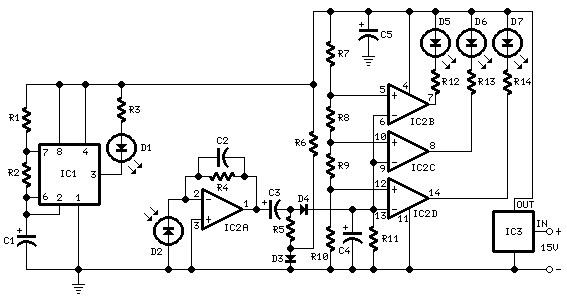
Parts:
- R1 10K 1/4W Resistor
- R2, R5, R6, R9 1K 1/4W Resistors
- R3 33R 1/4W Resistor
- R4, R11 1M 1/4W Resistors
- R7 4K7 1/4W Resistor
- R8 1K5 1/4W Resistor
- R10, R12-R14 1K 1/4W Resistors
- C1, C4 1µF 63V Electrolytic or Polyester Capacitors
- C2 47pF 63V Ceramic Capacitor
- C3, C5 100µF 25V Electrolytic Capacitors
- D1 Infra-red LED
- D2 Infra-red Photo Diode (see Notes)
- D3, D4 1N4148 75V 150mA Diodes
- D5-7 LEDs (Any color and size)
- IC1 555 Timer IC
- IC2 LM324 Low Power Quad Op-amp
- IC3 7812 12V 1A Positive voltage regulator IC
Device purpose:
This circuit is designed to aid in parking a vehicle near a garage wall during reverse maneuvers. LED D7 illuminates approximately 20 cm from the bumper, D7+D6 illuminates around 10 cm, and D7+D6+D5 indicates a distance of about 6 cm. These indicators provide alerts when approaching too closely to the wall. These distances can vary depending on the specifications of the used infra-red transmitting and receiving LEDs, and are primarily influenced by the color of the reflecting surface. Dark surfaces significantly reduce the device’s sensitivity. Consequently, this circuit can be employed in various applications such as liquid level detection or proximity sensing devices.
Circuit operation:
IC1 establishes an oscillator that drives the infra-red LED via 0.8mSec pulses at a frequency of 120Hz and a peak current of approximately 300mA. D1 and D2 are positioned facing the car along a short breadboard strip fastened to the wall, with a separation of a couple of centimeters. D2 captures the infra-red beam generated by D1 and reflected by the object in front. The signal is amplified by the input stage of IC2 and peak detection is performed by D4 and C4. Diode D3, along with R5 and R6, compensates for the forward diode drop of D4. DC voltages proportional to the distance of the reflecting object from D1 and D2 feed the inverting inputs of three voltage comparators. These comparators switch the LEDs on and off based on the voltage levels at their non-inverting inputs, which are set by a voltage divider resistor chain (R7-R10).
Notes:
- Power supply regulation is crucial for precise reference voltages (hence the use of IC3). The circuit can be powered by a commercially available wall plug-in power supply, delivering a DC output voltage within the range of 12-24V.
- Current consumption varies: LEDs off at 40mA; all LEDs on at 60mA at a 12V DC supply.
- The infra-red Photo Diode D2 must be of the type incorporating an optical sunlight filter – these components typically appear in black plastic cases. Some resemble TO92 transistors; in this case, the sensitive surface is the curved section, not the flat one.
- Avoid direct sunlight or artificial light hitting D1 and D2.
- If your car’s bumpers are dark, align the infra-red diodes with the (usually white) license plate or number plate.
- It is recommended to place the entire circuitry in a small box near the infra-red LEDs. The three signaling LEDs can be positioned far from the main box, at a height that is easily visible to the driver.
- The optimal setup involves bringing D2 closer to D1 (without a reflecting object) until D5 illuminates; then, slightly move it until D5 is clearly off. Typically, the optimum distance between D1 and D2 lies within the range of 1.5-3 cm.
- If you require a simpler circuit for driving a LED or a relay, consult the Infra-red Level Detector circuit.
circuit from http://www.redcircuits.com/