- Automated Dusk-to-Dawn Lamp Circuit Diagram
- Build a Light Sensor Circuit with an LED and Op-Amp
- Automatic Emergency Light Circuit Design: 555, LM317 & X1
- Automatic Light Controller with 7806 – Build Your Own!
- Pinewood Finish Line: Circuit Design & Lamp Illumination
- Schmitt Trigger Street Light Circuit Diagram – 8V, 4V Switching
- Simple Optical Switch with 555 Inverter
- Build Your Own Light/Dark Detector Circuit – 100K Sensitivity
- LED Photo Sensor: Build a 5V to 2V Light Detector Circuit
Simple Optical Switch with 555 Inverter
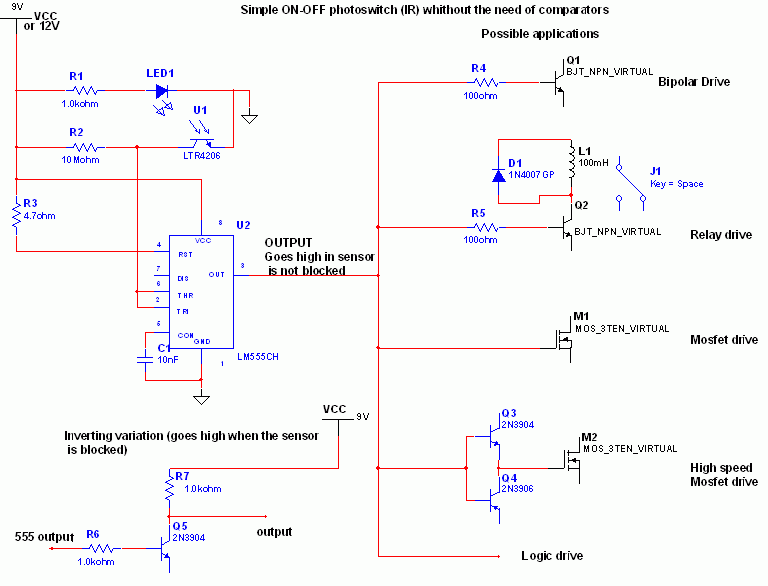
Circuit diagram
Introduction
The 555 timer is recognized as the most adaptable and widely used integrated circuit globally. This configuration demonstrates a straightforward inverting Schmitt trigger implementation.
Circuit explanation
Upon exposure to infrared illumination, the phototransistor becomes conductive, and the voltage between the 1Mohm resistor (a value chosen arbitrarily) decreases from VCC to lower levels. When this voltage falls below VCC/3, the 555 timer is activated and transitions to a high state (from 0 to VCC). The quantity of infrared light required to bring the phototransistor's collector to VCC/3 is dictated by the resistor (Vdrop = Icollector * R; therefore, if Vdrop equals 2*VCC/3, the resistance necessary to establish the current threshold is R=2*VCC/(Icollector*3)). A phototransistor exhibiting greater sensitivity would necessitate a smaller resistance value, while weaker phototransistors would benefit from higher resistance values. A trimmer resistor can also be utilized to precisely calibrate the activation threshold level. The precise timing characteristics of the phototransistor are not crucial. The 555 timer possesses substantial current-handling capabilities and is capable of driving a variety of devices, including bipolar transistors, relays, bipolar transistors combined with relays, MOSFETs, and totem-pole outputs, or providing a logic output (as illustrated).
For applications requiring activation upon gate blockage – such as a security system or a multistage coilgun – it is necessary to invert the output signal. This is achieved using a small bipolar transistor arranged in an inverting configuration (as depicted in the image) or by swapping the positions of the phototransistor and the resistor, resulting in a voltage drop below VCC/3 when the gate is blocked. The resistance value needed to deactivate the circuit at Icollector is determined by the formula: R=VCC/(Icollector*3).
More about components
Integrated circuits (ICs) are complex electronic circuits fabricated on a single semiconductor chip. The 555 timer itself is a prime example, containing multiple transistors, diodes, and resistors precisely arranged to perform its timer functions. In essence, the 555 timer is a miniaturized, self-contained electronic circuit, simplifying design and increasing reliability compared to discrete component circuits. It's a sophisticated example of semiconductor technology, allowing for compact and efficient electronic solutions. The 555 timer is a popular choice for hobbyists and professionals alike, valued for its simplicity, versatility, and readily available documentation. Its widespread usage is a testament to its robust performance and ease of integration into various circuit designs. The IC includes a timing capacitor, a few resistors, and a single transistor, which provide the necessary timing circuit that produces a specific output. The timing capacitor stores electrical charge to determine a specific timing duration. This specific timing duration is then used to generate an output signal in response to the input signal. The IC is a very versatile component that is frequently utilized in applications such as timing circuits, pulse generation, and oscillator circuits. This component is especially popular for beginners because of its small size, low cost, and readily available documentation. It is an integral part of a wide range of electronic circuits. Its availability has made it an excellent component for experimentation and for building a large number of electronic circuit designs.
circuit from http://www.electronics-lab.com/