- Build a 4-Stage Stabilised Power Supply with Short Circuit Protection
- Build Your Own 3-30V Adjustable DC Power Supply
- Build Your Own 9V 2A DC Power Supply Circuit
- Build Your Own: 1.3-22V Adjustable Power Supply Circuit
- Adjustable Current Limit: Dual Power Supply Design
- Build Your High-Performance 170V Hybrid Amplifier Power Supply
- Build Your 15V Regulated Power Supply Circuit – Simple & Powerful
- Transformerless 5V Power Supply Design Guide
- Build Your Own 24V 2A Variable DC Power Supply
- High Voltage Regulator: Design and Short Circuit Protection
- Boost Regulator Current: Design Your 1500mA Circuit
- Extend Smoke Alarm Battery Life with 12V Power
- 2 Watt Switching Power Supply: Build Your Own Circuit
- Variable Voltage & Current Power Supply: Build Your 0-3 Amp Circuit
- Build Your 24 Volt 3 Amp Power Supply Circuit
High Voltage Regulator: Design and Short Circuit Protection
Description
Numerous circuits for low voltage regulation exist. For higher voltages, specifically those utilized in valve circuit supplies, a different approach is necessary. Consequently, this straightforward regulator was designed to accommodate such voltages. This circuit is ideally suited for use in conjunction with the quad power supply for the hybrid amplifier, previously published within this issue. The regulator itself comprises just three transistors. A fourth transistor has been incorporated to provide current limiting functionality.
This circuit is a positive series regulator, employing a pnp transistor (T2) to minimize voltage drop. The operation of the circuit is remarkably simple. When the output voltage decreases, T4 pulls the emitter of T3 downwards, which in turn hardens T2, thereby restoring the output voltage. R4 restricts the base current of T2. C1, C2, and C3 have been added to enhance the circuit's stability.
These capacitors are connected in series to prevent excessive voltage across them during switch-on or a short-circuit condition. Capacitors with a rating of at least 100 V should be utilized for C1-C3. D1 protects T2 against potential negative voltages that may arise from short-circuit conditions or the connection of large capacitors to the output. Two zener diodes of 39 V are connected in series to generate the reference voltage, resulting in a 78 V supply for the base of T3.
Because R6 equals R7, the output voltage is doubled, reaching approximately 155 V. T4 functions as a buffer for the potential divider (R6/R7), allowing for the utilization of higher resistor values without affecting the output voltage due to the base current of T2 (which is roughly equivalent to the emitter current of T3). This design is not temperature compensated; however, it is sufficient for the intended application.
Circuit diagram:
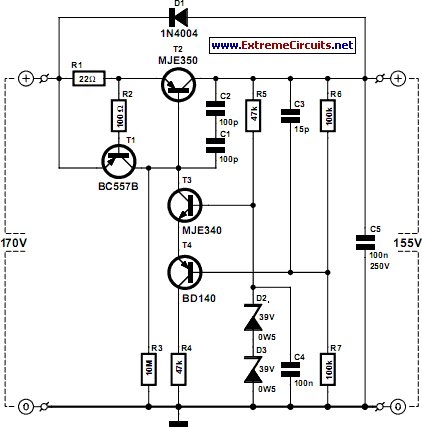
The current limiting section, built around T1, is uncomplicated. When the output current surpasses 30 mA, the voltage across R1 causes T1 to conduct. T1 then limits the base-emitter voltage of T2. R2 is needed to safeguard T1 from potentially excessive peak voltages across R1. R3 is required to initiate the regulator’s operation. Without R3, no voltage would be present at the output, consequently preventing the base current in T2. R3 enables T2 to conduct a small amount, sufficient for the regulator to reach its operational state.
During normal operation with a voltage drop of 15 V across T2 and a current of approximately 30 mA, no additional cooling of T2 is necessary. The junction temperature then reaches 70 °C – a temperature that could cause burns if not handled with caution! The lower the input voltage, the greater the current that this regulator can supply. This current is defined by the Safe Operation ARea (SOAR) of T2. In the event of a short circuit and an input voltage of 140 V, the current is approximately 30 mA, and T2 would require a heatsink of at least 10 K/W under these conditions.
To increase the output voltage, a larger value for R6 should be used. If a higher reference voltage is desired, the MJE350 integrated circuit can be substituted for T4. If only a few milliamps are required, the inclusion of T4 and R4 can be omitted. The potential divider (R6/R7) can then be directly connected to the emitter of T3. The circuit's ripple suppression is approximately 50 dB. The quiescent current is 2.5 mA, and for low currents, the dropout voltage is only 1.5 V.