- Build a 4-Stage Stabilised Power Supply with Short Circuit Protection
- Build Your Own 3-30V Adjustable DC Power Supply
- Build Your Own 9V 2A DC Power Supply Circuit
- Build Your Own: 1.3-22V Adjustable Power Supply Circuit
- Adjustable Current Limit: Dual Power Supply Design
- Build Your High-Performance 170V Hybrid Amplifier Power Supply
- Build Your 15V Regulated Power Supply Circuit – Simple & Powerful
- Transformerless 5V Power Supply Design Guide
- Build Your Own 24V 2A Variable DC Power Supply
- High Voltage Regulator: Design and Short Circuit Protection
- Boost Regulator Current: Design Your 1500mA Circuit
- Extend Smoke Alarm Battery Life with 12V Power
- 2 Watt Switching Power Supply: Build Your Own Circuit
- Variable Voltage & Current Power Supply: Build Your 0-3 Amp Circuit
- Build Your 24 Volt 3 Amp Power Supply Circuit
Build Your High-Performance 170V Hybrid Amplifier Power Supply
Description
This power supply was designed for use with the ‘Simple hybrid amp’ published elsewhere in this issue. It is, of course, suitable for use in other applications as well. We’ve employed a cascade generator for the 170 V, a switch mode supply for the 16 V, a series regulator for the 12 V and a separate transformer for the 6.3 V filament supply. We’ve selected an LT1074CT (IC1) for the regulator, implying that the circuit can be built with relatively standard components and will have a high efficiency. The power loss is reduced with this device compared to a linear voltage regulator.
This allows us to utilise a higher transformer voltage and a smaller cascade section to generate the 170 V (which is required for the SRPP stage in the amplifier). The lower input current also results in smaller losses within the bridge rectifier (D1 to D4). A standard 12 V regulator (IC2) stabilises the voltage for the buffer stage. When an ECC83 (12AX7) is used in the hybrid amp, this 12 V can be used to power the filaments in the valve as well, although 12.6 V is needed in practice.
The current drawn by the valve is approximately 150 mA, necessitating a heatsink for IC2. This could be a small version of an SK129 heatsink from Fischer (38.1 mm, 6.5 K/W). To increase the voltage by 0.6 V, we’ve added diode D7 to the ground connection of the regulator. If a 12 V output is required, JP1 short-circuits D7. IC1 and D5 require more cooling, and for this, a 63.5 mm version of the SK129 will suffice (4.5 K/W).
Both components can be mounted on opposite sides of the heatsink. It is crucial to ensure they are electrically isolated from each other and the heatsink! Please refer to the website of Linear Technology (www.linear.com) and take note of the layout recommendations regarding the use of an LT1074. Standard chokes can be used for L1 and L2, rated at 5 A. If you want to reduce residual 100 kHz switching frequency, an extra LC filter at the output can be added.
Circuit diagram:
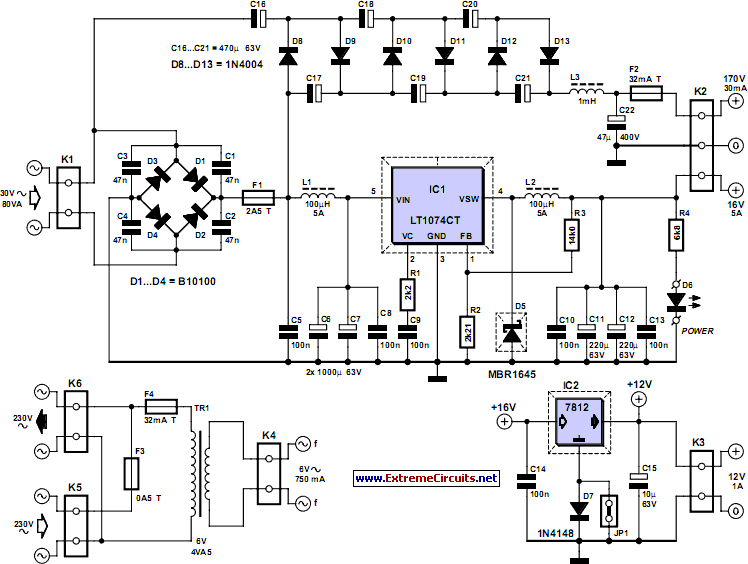
The diodes in the bridge rectifier are B10100’s. These are Schottky rectifiers, which have a low forward voltage drop (ranging from 0.7 to 0.8 V at 10 A). We have chosen diodes with a reverse voltage rating of 100 V, allowing for the use of an LT1074HVCT instead. This device can handle an input voltage of up to 60 V, enabling the use of a 40 VAC transformer. The same cascade circuit can then easily generate 220 VDC. The standard LT1074CT can cope with up to 45 V, so IC1 is used fairly close to the limits of its specifications in this circuit.
A cascade circuit generates the HT supply for the valve. It would also have been possible to use a separate transformer with a bridge rectifier and smoothing capacitor to generate this voltage. However, this would require a 4.5 VA transformer with a 40 V secondary and connecting it ‘wrong’ way round. As this is not a standard transformer, we opted for this approach. The source for the cascade generator is now an 80 VA transformer. The capacitors in the cascade circuit have higher values than strictly necessary.
This simplifies the calculation of the expected output voltage. In our case, this is 4 x 30 x V2V for the no-load voltage, which amounts to nearly 170 V. L3 and C22 filter out any HF interference coming from IC1. When the cascade supplied 20 mA, the output voltage dropped to 140 V. At heavier loads, we recommend a smaller cascade circuit and a higher transformer voltage (and also the use of an LT1074HVCT due to the increased input voltage). The filament voltage for the valve is generated by a 4.5 VA transformer, which in practice produced a slightly above 6 V output, coming closer to the required 6.3 V.
Another solution is to use a special transformer or a stabilised 6.3VDC supply. Any of these will work, so the choice is down to your own preference. It is in principle possible to use the supply for two channels. However, if an ECC88 is used in the amplifier, it may be necessary to employ a separate cascade generator for each channel.