- Protect Your Line: Building a Lightning Surge Shield
- Build a Telephone Ringer: Circuit & Control
- Cellular Phone Call Detector: Build Your Own Schematic
- Telephone Amplifier Circuit Diagram – Boost Your Voice!
- Build a Cell Phone Call Detector with Flashing LED
- Ringing Phone Light Flasher Circuit Diagram Build Guide
- Soft Musical Ringer Circuit Diagram: Build Your Own!
- Build a 48V Hold Music Circuit Diagram
Telephone Amplifier Circuit Diagram – Boost Your Voice!
Circuit Diagram
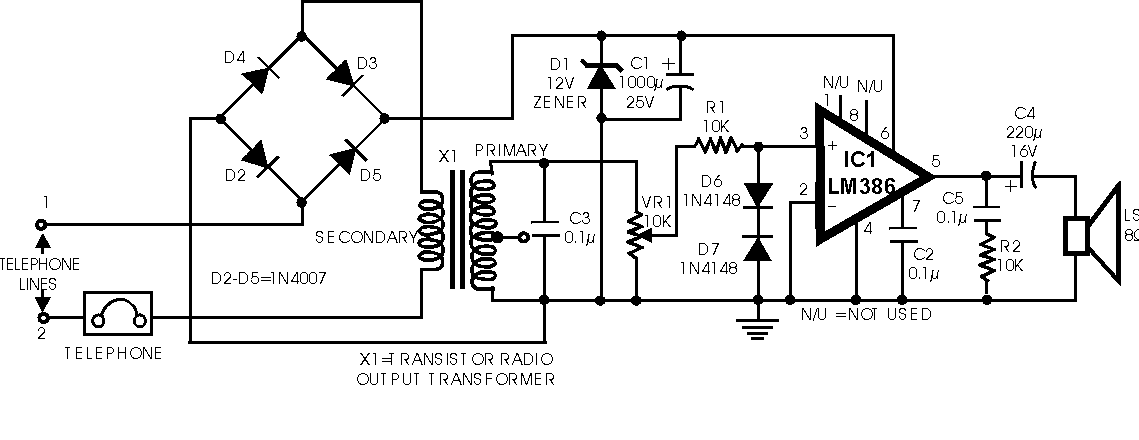
A frustrating situation frequently arises when communicating with a remote caller, where the voice is excessively faint and difficult to understand. To address this, a readily assembled and testable amplifier circuit is presented here. This design requires no additional power source, drawing its energy directly from the telephone line. The resulting amplification will provide a satisfactory volume level for clear telephone conversations within a domestic environment. A volume control is incorporated to allow the user to adjust the sound output to their preference.
IC LM386 Details
The core of this circuit is the integrated circuit LM386, a versatile audio amplifier IC. This compact component is widely utilized in low-power audio applications, known for its ability to amplify audio signals efficiently. The LM386 is renowned for its low power consumption and ease of use, making it a popular choice for various projects, including this telephone amplifier. It’s a bipolar junction transistor (BJT) IC, optimized for audio amplification.
Diodes D6 and D7 play a crucial role in limiting the strength of the incoming signal. These diodes prevent excessive voltage spikes from damaging sensitive components within the circuit. They operate as signal clipping diodes, preventing over-amplification and distortion. They are standard silicon diodes, typically rated for applications where signal protection is essential.
Transformer X1, originally intended for a transistor radio’s output, is repurposed in this circuit. The original secondary (output) winding is connected in series with the telephone lines. As speech signals travel along the lines, changes in the magnetic flux through the transformer’s core induce a voltage across the primary winding. This AC signal is subsequently fed into the input of the IC LM386. The Zener diode D1, with a breakdown voltage ranging from 6 to 12 volts, ensures correct power supply polarity, independent of the line’s voltage.
The circuit employs a bridge configuration utilizing diodes D2 through D5 to create a polarity guard. This configuration safeguards against improper power supply connections, ensuring consistent amplifier performance. The volume control, represented by potentiometer VR1, allows for dynamic adjustment of the amplified sound's level. The input signal is capped by Diodes D6 and D7, limiting the voltage to a maximum of ±700 mV.
The circuit is intended to be connected in series with the telephone instrument and telephone lines, as illustrated in the diagram.