- Build Your Smart Temperature-Controlled Switch Circuit
- Energy Leak Detection Circuit: Build Your 20°C Thermistor Detector
- Build Your Precise Heating System Thermostat Circuit
- Fridge Open Alarm Circuit: Build Your Smart Protection System
- Fridge Door Alarm Circuit: Robust Design for 1.3V Operation
- Build Your Fridge Door Alarm Circuit – 20 Second Alerts
- Build Your Fire Alarm: Thermistor Circuit Diagram (10K)
- Build Your 3-Degree Thermostat Circuit with LM339
- Temperature Monitor Circuit Diagram: 2-Channel Alarm Design
- Build Your Precise 12V Heating System Thermostat Circuit
- Build Your Fridge Door Alarm: 20-Second Timer Circuit
- Build Your 15k-45k Temperature Alarm Circuit
- Temperature-Controlled Fan Circuit Diagram – Build Your Smart System!
- Temperature Control Circuit: 10uV Precision & 140°C Limits
- Build Your Hot Water Level Indicator Circuit
Build Your 3-Degree Thermostat Circuit with LM339
Circuit diagram
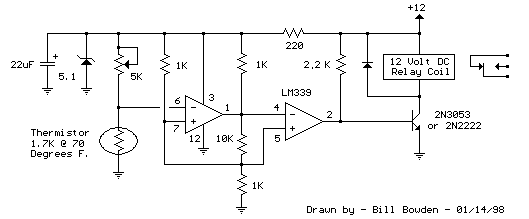
Description
This document presents a basic thermostat circuit designed for controlling a relay and providing power to a small heating element via the relay contacts. The relay contacts are required to have a current rating exceeding the demands of the heating element.
Temperature fluctuations are monitored using a (1.7K @ 70F) thermistor, integrated in series with a 5K potentiometer. This combination generates approximately 50 millivolts per degree Fahrenheit at the input of the LM339 voltage comparator. The two 1K resistors, connected to pin 7, establish the reference voltage, setting it to half the supply voltage and defining the hysteresis range at roughly 3 degrees or 150 millivolts. This hysteresis range – the temperature span within which the relay engages and disengages – can be modified using the 10K resistor situated between pins 1 and 7. Increasing this resistance value will result in a narrower range.
LM339 Voltage Comparator
The LM339 is a versatile comparator integrated circuit widely utilized in analog circuits. It compares two input voltages and outputs a high or low voltage based on which input is greater. In this circuit, the LM339 acts as a voltage comparator, efficiently detecting the temperature difference generated by the thermistor. This IC simplifies the temperature sensing process and provides a stable and accurate output for controlling the relay. Its operation is based on comparing the voltage across the thermistor with a reference voltage, enabling precise temperature control.
In operation, the series resistor is adjusted to ensure the relay switches off precisely at the desired temperature. A 3-degree variation in temperature should trigger the relay to switch back on and remain active until the temperature returns to the set point. The relay behavior can be reversed by swapping the positions of the 5K potentiometer and thermistor. The 5.1-volt zener diode stabilizes the circuit voltage, preventing operational disruptions due to minor variations in the 12-volt supply. The voltage across the thermistor is designed to be approximately half the supply voltage – around 2.6 volts – when the temperature falls within the 3-degree range determined by the potentiometer. Various thermistors can be employed, but their resistance should be above 1K ohm at the operating temperature. The series resistor is selected to be roughly twice the thermistor's resistance to center the adjustment range.