- Build Your Smart Temperature-Controlled Switch Circuit
- Energy Leak Detection Circuit: Build Your 20°C Thermistor Detector
- Build Your Precise Heating System Thermostat Circuit
- Fridge Open Alarm Circuit: Build Your Smart Protection System
- Fridge Door Alarm Circuit: Robust Design for 1.3V Operation
- Build Your Fridge Door Alarm Circuit – 20 Second Alerts
- Build Your Fire Alarm: Thermistor Circuit Diagram (10K)
- Build Your 3-Degree Thermostat Circuit with LM339
- Temperature Monitor Circuit Diagram: 2-Channel Alarm Design
- Build Your Precise 12V Heating System Thermostat Circuit
- Build Your Fridge Door Alarm: 20-Second Timer Circuit
- Build Your 15k-45k Temperature Alarm Circuit
- Temperature-Controlled Fan Circuit Diagram – Build Your Smart System!
- Temperature Control Circuit: 10uV Precision & 140°C Limits
- Build Your Hot Water Level Indicator Circuit
Energy Leak Detection Circuit: Build Your 20°C Thermistor Detector
Description
This delicate circuit is fundamentally a comparator, detecting very minor temperature shifts relative to the surrounding temperature. It was initially designed to identify drafts around doors and windows that cause energy loss, yet it can also be utilized in various applications requiring a precise temperature change sensor. Two LEDs are employed to signal whether the temperature alteration indicates a rise (Red LED) or a drop (Green LED) compared to the ambient temperature.
Circuit operation:
IC1 functions as a bridge detector and amplifier: its output voltage increases when temperature rises and vice-versa. This occurs because the n.t.c. resistor R2 reduces its resistance value as temperature increases and decreases, thereby unbalancing the bridge constructed by R1, R2, R4, R5. IC2A and IC2B comprise a window comparator, and R8 serves as the sensitivity control. Prior to commencing a measurement, the circuit must be calibrated using R1 to ensure that both LEDs remain off. If R8 is set to zero resistance, the circuit sensitivity will be at its maximum, and one of the LEDs will illuminate when a minimal temperature difference is detected. As the value of R8 increases, the circuit sensitivity will diminish.
Circuit diagram:
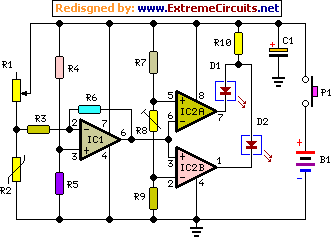
Parts:
- R1 = 22K - Linear Potentiometer (See Notes)
- R2 = 15K @ 20°C Thermistor (See Notes)
- R3 = 10K - 1/4W Resistor
- R4 = 22K - 1/4W Resistor
- R5 = 22K - 1/4W Resistor
- R6 = 220K - 1/4W Resistor
- R7 = 22K - 1/4W Resistor
- R8 = 5K - 1/2W Trimmer Cermet
- R9 = 22K - 1/4W Resistor
- R10 = 680R - 1/4W Resistor
- C1 = 47µF - 63V Electrolytic Capacitor
- D1 = 5mm. Red LED
- D2 = 5mm. Green LED
- IC1 = TL061 Low current BIFET Op-Amp
- IC2 = LM393 Dual Voltage Comparator IC
- P1 = SPST Pushbutton
- B1 = 9V PP3 Battery
Notes:
- The Thermistor value can be selected within the 10K - 22K @ 20°C range.
- R1 value should be approximately twice the Thermistor value @ 20°C, implying the use of a 22K Thermistor would necessitate a 47K potentiometer.
- To facilitate rapid detection of temperature fluctuations, a Thermistor with the smallest possible case is recommended.
- If only a single LED is needed to display a temperature alteration, regardless of whether it’s increasing or decreasing, D2 can be omitted, and pin #1 of IC2B must be connected to pin #7 of IC2A.