- 700Hz Pulse Generator & Signal Tracer Circuit
- Build Your Own 66 Melody Generator Circuit Diagram
- Build Your Own 9V Surf Noise Simulator
- Build Your Own Music: UM66 Circuit Diagram (8 Ohm)
- Build Your Powerful 5-Tone Siren Circuit Diagram
- Cuckoo Song Generator: 667Hz & 545Hz
- DIY Bell Tone Generator Circuit Schematic
- Cricket Chirp Generator Circuit: Build Your Realistic Sound
- Build a 4-Tone Siren Circuit with One IC
- Build Your Own Electronic Canary: Circuit Diagram & Chirp Secrets
- Build Your 8 Sound Effects Generator with HT2884
- UM3561 Sound Effects Generator Circuit Diagram - Build Your Own!
- Low Distortion Audio Sine Wave Oscillator Circuit Diagram
- Cuckoo Sound Generator: Build Your Own Realistic Bird Song
- Dual Tone Siren Circuit Diagram – Build Your Own!
Build Your Powerful 5-Tone Siren Circuit Diagram
Description
This diverse alarm siren is beneficial for security systems and reverse signals, among other applications. It generates five distinct audio frequencies and is significantly more noticeable than a single-tone siren. The circuit’s construction relies on the widely-used CMOS oscillator-and-divider integrated circuit, IC 4060, alongside the compact audio amplifier, LM386. IC 4060 serves as the multi-frequency generator. A 100µH inductor is positioned at the input of IC 4060, enabling it to oscillate within a frequency range of approximately 5MHz RF. IC 4060 simultaneously divides RF signals into audible and ultrasonic ranges. Various audio signals with differing frequencies are accessible through pins 1, 2, 3, 13 and 15 of IC1 (component IC1).
Circuit diagram:
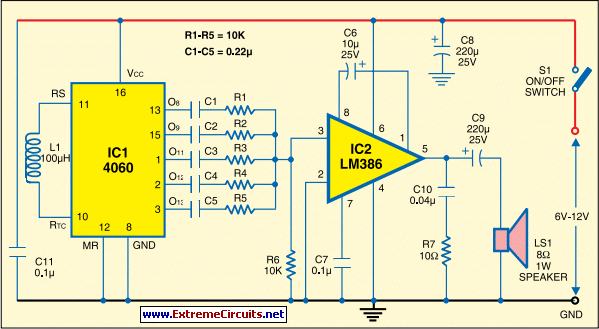
These varied frequency signals are combined and directed towards the audio amplifier, built around IC LM386. The output generated by IC2 is then sent to the speaker via capacitor C9. For an amplified output, a power amplifier, such as the TBA810 or TDA1010, may be incorporated. Only five output signals from IC1 are utilized, as the remaining five outputs (pins 4 through 7 and 14) produce ultrasonic signals, which are beyond the range of human hearing. The circuit should be assembled upon a standard-purpose printed circuit board and contained within a suitable enclosure. A regulated power supply of 6V-12V (or a battery) can be utilized to power the system.
Integrated Circuits Detail
IC 4060 is a versatile CMOS integrated circuit predominantly utilized as an oscillator-and-divider. This component’s core function is to generate multiple audio tones. It achieves this by producing a series of oscillations at varying frequencies. The IC’s internal circuitry effectively divides the input RF signal into different audible and ultrasonic frequency ranges. This functionality is crucial for creating a multi-tone siren. Its design incorporates both oscillator and division capabilities, offering a compact solution for generating diverse audio signals. The IC’s performance is often influenced by external components, particularly the inductor and capacitors used in the circuit.
IC LM386 is a low-power audio amplifier IC. It is commonly employed in small electronic projects due to its simple design and efficient amplification capabilities. This integrated circuit takes a relatively weak audio signal and boosts its amplitude, making it suitable for driving small speakers. The LM386’s advantages include its low power consumption, ease of use, and availability in various package types. It’s a frequently selected choice for projects requiring a compact and affordable audio amplifier. The LM386’s internal circuitry incorporates a gain stage and a power supply circuitry to achieve its amplification function.
circuit from http://www.extremecircuits.net/2010/05/multitone-siren.html