- Water Pump Relay Circuit: Build Your 12V Control System
- Plant Watering Circuit: Build Your Smart Sensor!
- Automatic Water Tank Level Control Circuit Diagram
- DIY Water Level Monitor: Build Your Smart Tank Circuit
- Water Level Alert Circuit: Build Your Own
- Water Leak Detection Circuit Diagram 4093 Alarm
- Build Your Rain Detector Circuit – 1N4001 & C106B1
- Salt Percentage Indicator Circuit Diagram
- Build a Smart Plant Watering System with a 3V Circuit
Build a Smart Plant Watering System with a 3V Circuit
A brightly shining LED indicates the need to water a plant
The circuit consumes very little power, operating on a 3V supply
Circuit Diagram
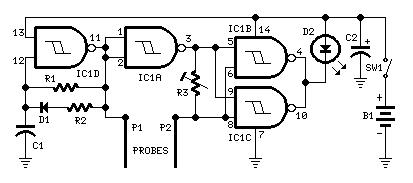
Components:
- R1 470K 1/4W Resistor
- R2 3.3K 1/4W Resistor
- R3 100K 1/2W Trimmer Cermet
- C1 1nF 63V Polyester Capacitor
- C2 47µF 25V Electrolytic Capacitor
- D1 1N4148 75V 150mA Diode
- D2 5mm. Red LED
- IC1 4093 Quad 2 input Schmitt NAND Gate IC
- P1, P2 Probes (See text)
- SW1 SPST Slider Switch
- B1 3V Battery (2 AA 1.5V Cells in series)
Device Purpose:
This circuit is designed to signal when a plant requires watering. The LED emits at maximum intensity when the soil within the flower pot is excessively dry; it diminishes progressively as the moisture level within the pot increases, ceasing to operate once the ideal moisture level is attained. This condition is achieved through the adjustment of R3.
Integrated Circuits (ICs) play a crucial role in this circuit. The 4093 is a versatile quad Schmitt-trigger NAND gate integrated circuit. These ICs are commonly used as building blocks in digital logic circuits, offering robust switching characteristics and the ability to generate precise square wave signals. The Schmitt trigger input provides hysteresis, minimizing noise sensitivity and ensuring stable operation. The quad configuration enables the creation of complex digital circuits with multiple inputs and outputs, allowing for versatile control and monitoring functions. The 4093's precise switching behaviour allows for creating reliable square waves.
Circuit Operation:
IC1D generates a square wave oscillation with an approximate 10/90 mark-space ratio. This signal is fed to probe P1, and its inverted version, produced by IC1A, is compared with the signal captured by P2, utilizing the NAND gates within IC1B and IC1C in parallel, thereby driving the LED. When a low resistance exists between the probes due to a high water content in the flower pot, the LED remains off, gradually illuminating as the resistance between the probes increases.
Notes:
- A square wave is employed to avert probe oxidation.
- Probes can consist of long nails, carbon rods obtained from discarded exhausted 1.5V batteries, or even a couple of screwdrivers.
- The probes must be inserted into the pot’s ground a few inches apart.
- Owing to the 3V supply, the LED does not require a current-limiting resistor.
- Power consumption: LED off = 50µA; LED fully on = 1mA.
- To deactivate the circuit, short the probes. In this scenario, SW1 can be omitted.
- Utilizing a high-efficiency LED, brightness variations are more noticeable. In this case, a current-limiting resistor might be necessary.
circuit from http://www.redcircuits.com/