- Water Pump Relay Circuit: Build Your 12V Control System
- Plant Watering Circuit: Build Your Smart Sensor!
- Automatic Water Tank Level Control Circuit Diagram
- DIY Water Level Monitor: Build Your Smart Tank Circuit
- Water Level Alert Circuit: Build Your Own
- Water Leak Detection Circuit Diagram 4093 Alarm
- Build Your Rain Detector Circuit – 1N4001 & C106B1
- Salt Percentage Indicator Circuit Diagram
- Build a Smart Plant Watering System with a 3V Circuit
Plant Watering Circuit: Build Your Smart Sensor!
Circuit diagram:
Description
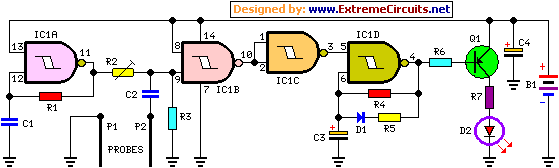
This device is designed to indicate when a plant requires watering. A light-emitting diode (LED) flashes at a low frequency when the soil in the flower pot is deficient in moisture, ceasing to flash when the moisture level increases. Adjusting resistor R2 allows the user to adapt the circuit’s sensitivity to different soil types, pots, and probe types.
Improvements:
This small gadget has enjoyed considerable success amongst electronics enthusiasts since its initial appearance on this website in 1999. Nevertheless, during the correspondence exchanged over many years with numerous amateur circuit designers, several suggestions and criticisms prompted a thorough revision of the circuit, necessitating the addition of four resistors, two capacitors and one transistor.
This resulted in a more stable and straightforward-to-assemble device, featuring a more visible flashing indicator without relying on excessively bright LED devices. Extensive testing was conducted using various flower pots and probes. However, as can be reasonably anticipated, variations across different pots and probe types proved to be exceedingly high, with typical resistance values across two 60mm long probes driven fully into the pot’s ground about 50mm apart measuring around 500 to 1000 Ohm when the ground contained a high water content, and approximately 3000 - 5000 Ohm when the ground was dry.
Circuit operation:
Integrated circuit IC1A, along with associated components R1 and C1, forms a 2KHz square wave oscillator, feeding one gate input of integrated circuit IC1B through the voltage divider formed by resistors R2 and R3, adjustable via trimmer resistor R2. When the resistance across the probes is low (as when sufficient water is present in the pot), capacitor C2 diverts the square wave to ground, effectively blocking integrated circuit IC1B, and its output goes to a high status. Integrated circuit IC1C inverts this high status to a low status, thereby maintaining integrated circuit IC1D blocked; the LED remains off. However, when the ground in the flower pot is becoming depleted of moisture, the resistance across the probes will increase, and capacitor C2 is no longer able to divert the square wave to ground.
Consequently, the output of integrated circuit IC1B begins to transmit the 2kHz signal to integrated circuit IC1C, which, in turn, passes it to the oscillator circuit built around integrated circuit IC1D. No longer disabled by a low-level input, integrated circuit IC1D’s oscillator slowly pulses the base of transistor Q1 low, causing the LED to flash, signifying the necessity to water the plant.
The brief low pulse driving the base of Q1 is, in fact, a burst of 2kHz pulses, meaning the LED flickers approximately 2,000 times per second - appearing to the human eye as if the LED were steadily on for the entire duration of the pulse.
Parts:
- R1 = 470K
- R2 = 47K
- R3 = 100K
- R4 = 470K
- R5 = 3.3K
- R6 = 15K
- R7 = 100R
- C1 = 1nF-63V
- C2 = 330nF-63V
- C3 = 10µF-25V
- C4 = 10µF-25V
- D1 = 1N4148
- D2 = 5mm. Red LED
- Q1 = BC557 PNP Transistor
- P1 = Probe (See Notes)
- P2 = Probe (See Notes)
- B1 = 3V Battery (2xAA, N or AAA 1.5V Cells in series)
- IC1 = 4093 = Quad 2 input Schmitt NAND Gate IC
Notes:
- A square wave is utilized to mitigate potential issues arising from probe oxidation.
- Probes are constructed using two pieces of uninsulated, stiff lighting cable, measuring approximately 60mm in length.
- Probes should be driven fully into the pot’s ground about 30 - 50mm apart. Please note that all parameters regarding probe material, dimensions, and spacing are not critical.
- Current consumption: LED off = 150µA; LED on = 3mA for 0.1 sec. every about 2 sec. allowing the battery to last for years.
- The quiescent current consumption is so low that the utilization of a power on/off switch was deemed unnecessary. In any case, to switch the circuit completely off, you can short the probes.
Making Notes:
The total cost is USD ($6.00-, including tax). It is easily assembled. If you construct this, you should utilize a super bright green LED. Otherwise, you may not be able to recognize when watering is needed, because the LED's light is dimmed. Therefore, I’ve replaced the 5mm red LED with a 5mm super bright green LED. (You should consider that you have to place it into the case, as well).
Furthermore, I have employed a 3 volt lithium battery (CR2032) and its holder. It is inexpensive and has a small size. I manufactured this 2 weeks ago. There was no problem until now. I have been watering for approximately 5 days or so. R2(VR) setting tip: If you are constructing this, pour water onto the plant and then adjust R2 to make the LED off. It is straightforward, and represents the end of the assembly process. That is all. P.S: I recommend the lead-free soldering for plants.