- 12V Motor Speed Controller/Dimmer Circuit Design
- DC Motor Speed Controller: 1.4V Variable Voltage Circuit
- Discrete 8-Bit PWM Generator Circuit Design
- Stepper Motor Drive with TDA2030 Circuit Design
- Varying Brightness AC Lamp Circuit Design
- DIY Temperature-Controlled Soldering Iron Circuit Diagram 400°C
- Unipolar Stepper Motor Driver Circuit Diagram
- Build Your Own Fan Control
- 12V DC Motor Control Circuit: Build Your Own!
- Variable Power Controller with 555 Timers
- 555 PWM Speed Control: Circuit Diagram & Explanation
- Pulse Width Modulation DC Motor Control: A Simple 6V Circuit
- Build Your Own Stepper Motor Controller Circuit 1K
12V DC Motor Control Circuit: Build Your Own!
Circuit diagram
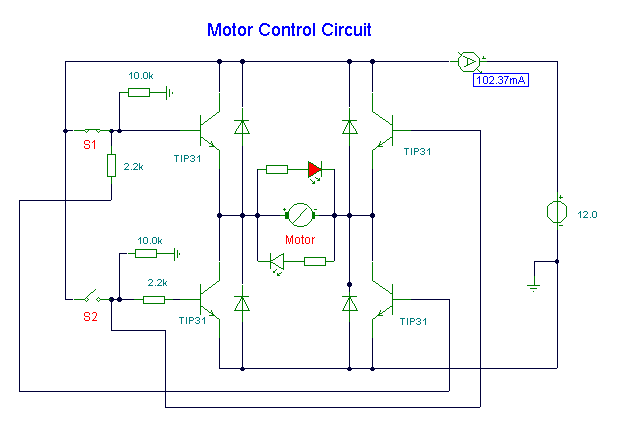
Notes:
In this configuration, S1 and S2 are initially off-state push-to-close switches. The semiconductors are available in red or green coloration and serve solely as visual cues for polarity. Adjustment of the TIP31 transistors might be required according to the motor’s specifications. It is important to acknowledge that operation under load results in increased current draw. This design was created for powering a small motor intended for controlling the movement of window coverings. A key benefit compared to automatic systems is the ability to precisely manage the amount of illumination entering a room. The four diodes surrounding the motor are back EMF diodes, selected to appropriately match the motor's characteristics. For a 12V motor consuming 1amp when under load, 1N4001 diodes are typically utilized.
More about components
Integrated circuits, often abbreviated as ICs, are complex electronic circuits miniaturized onto a single semiconductor chip. These components are fundamental to modern electronics, providing compact and efficient solutions for a wide range of functions. They are comprised of numerous transistors, diodes, resistors, and capacitors interconnected to perform specific tasks, such as amplification, switching, and logic operations. The TIP31 transistor, frequently used in this circuit, is a three-terminal bipolar junction transistor. It is a common-emitter amplifier and switch, capable of handling moderate current levels. The TIP31 is a versatile component well-suited for controlling motor speed and direction in applications like this one. Its operation relies on the control of current flow through its base and collector terminals, allowing for precise control of the connected motor. These ICs significantly contribute to the circuit’s overall performance and responsiveness. They are crucial for managing the motor’s power consumption and providing the required switching capabilities. Proper selection of ICs is vital to ensure optimal performance and reliability of the entire circuit. They are designed for specific applications and their proper functioning is dependent on adherence to operating conditions and voltage/current specifications.