- Build Your 15-Second Courtesy Light Circuit Today
- Brightness Controller: Build a 1.5V LED/Lamp Circuit
- 12V DC Dimmer Circuit: Build Your Own Mood Lighting
- TRIAC Light Dimmer Circuit: Build Your 350W Dimmer
- Dome Lamp Dimmer Circuit: Build Your 700Hz Dimming System
- Build Your Automotive Lamp Dimmer: Circuit Diagram & Control
- Delayed Mains Lamp Circuit: Build Your 15-Second Timer
- 12 Volt Lamp Dimmer Circuit Diagram: Control Brightness with 555
- Sunrise Lamp Circuit: Build a 20-Minute Illumination Project
- 1.5 Hour Lamp Fader Sunset Lamp Circuit Diagram
- Build a 120V Lamp Dimmer: Full Wave Circuit Explained
- Build Your Inspiring 12 Volt Lamp Fader Circuit
- Illuminating Red Eyes
Sunrise Lamp Circuit: Build a 20-Minute Illumination Project
Circuit diagram
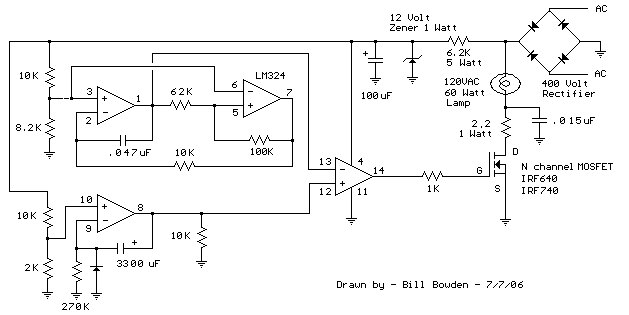
A 120VAC lamp is gradually illuminated over an approximate 20-minute timeframe. The diode bridge provides 120 DC to the MOSFET and a 60 watt lamp. A 6.2K, 5 watt resistor and zener diode are utilized to decrease the voltage to 12 volts DC for the circuit's power supply. The diode bridge must be rated for a minimum of 200 volts and 5 amps. During operation, a 700 Hz triangle waveform is generated at pin 1 of the LM324, resulting in a slow increasing voltage at pin 8. These two signals are compared at pins 12 and 13 to produce a variable duty cycle rectangular waveform at pin 14, which controls the MOSFET and the brightness of the 60 watt lamp. Upon power application, the lamp begins to light within a minute or so, slowly intensifying to its full intensity in approximately 20 minutes. Adjustments to the 270K resistor at pin 9 can alter this duration. The 2.2 ohm resistor and .015uF capacitor connected to the lamp are employed to mitigate Radio Frequency Interference (RFI). The diode at pins 9 and 10, along with the 10K resistor on pin 8, are utilized to discharge the 3300uF capacitor when power is discontinued. It is recommended that power be switched off for several minutes prior to restarting.
LM324
The LM324 is a versatile integrated circuit (IC) widely used as a quadruple operational amplifier. This particular IC contains four independent operational amplifiers, each featuring high open-loop gain, input bias current compensation, and slew rate control. It’s a commonly employed component in various analog circuit designs, including amplifiers, filters, and instrumentation. The 700 Hz triangle waveform generation relies on the LM324’s ability to generate accurate and stable waveforms.
Caution: This circuit is directly connected to the AC line and presents a considerable risk if any part is touched while it is energized. Exercise extreme caution and refrain from touching any components while the circuit is connected to the AC line. A 9 volt battery connected across the 12 volt zener diode can be used to verify the basic functionality. The DC voltages at pins 1, 2, 3, 5, 6, and 7 will generally measure around 4.3 volts if the circuit is functioning correctly. If these DC voltages are accurate, a variac can be employed to gradually apply the full line voltage and confirm proper operation.