- Build Your 15-Second Courtesy Light Circuit Today
- Brightness Controller: Build a 1.5V LED/Lamp Circuit
- 12V DC Dimmer Circuit: Build Your Own Mood Lighting
- TRIAC Light Dimmer Circuit: Build Your 350W Dimmer
- Dome Lamp Dimmer Circuit: Build Your 700Hz Dimming System
- Build Your Automotive Lamp Dimmer: Circuit Diagram & Control
- Delayed Mains Lamp Circuit: Build Your 15-Second Timer
- 12 Volt Lamp Dimmer Circuit Diagram: Control Brightness with 555
- Sunrise Lamp Circuit: Build a 20-Minute Illumination Project
- 1.5 Hour Lamp Fader Sunset Lamp Circuit Diagram
- Build a 120V Lamp Dimmer: Full Wave Circuit Explained
- Build Your Inspiring 12 Volt Lamp Fader Circuit
- Illuminating Red Eyes
Dome Lamp Dimmer Circuit: Build Your 700Hz Dimming System
Description
Occasionally, a small illumination within a vehicle would significantly aid a passenger, yet the standard dome light possesses excessive brightness for safe operation. The adjustment circuit depicted in figure 1 can be incorporated into an existing dome light or utilized within a novel passenger spot lamp. The primary op-amp produces a 700 Hz triangular wave, which is compared to a predefined reference voltage by the secondary op-amp. Whenever the triangular wave exceeds the reference voltage, the transistors activate, supplying current to the bulb.
Op-Amp Dimmer Circuit
This circuit employs two operational amplifiers to create a variable resistance for controlling the brightness of a light source. The upper op-amp generates a 700 Hz sawtooth waveform, while the lower op-amp monitors a setpoint voltage. By adjusting the potentiometer, the width of the pulses delivered to the lamp can be modified, consequently altering the average voltage applied. Dimming is achieved when the potentiometer is positioned near the higher voltage setting. Unlike a traditional power rheostat, the TIP32 switches the current on and off, resulting in minimal power dissipation and eliminating the need for a heat sink.
Circuit Diagram
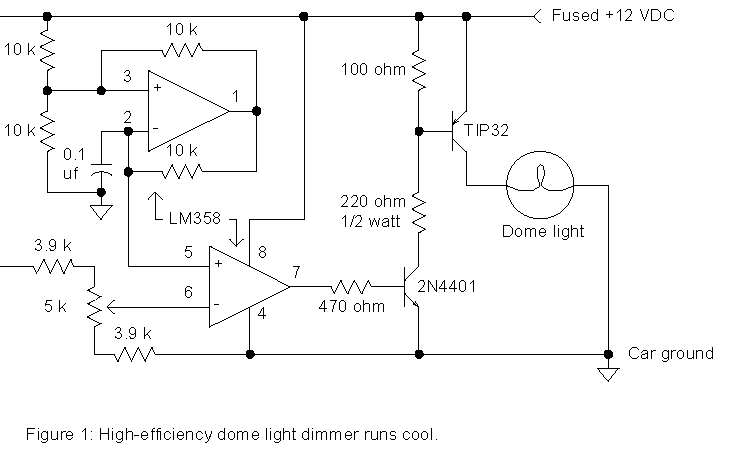
Numerous automobiles utilize a single-wire system for powering lamps, employing the vehicle’s body as the return path. Therefore, the adjustment must interrupt the positive lead, as shown. To implement this, cut the wire connecting to the lamp and connect the lamp's output to the collector of the TIP32. Connect the battery’s power input to the circuit, and establish a ground wire from the car’s chassis to the circuit. This ground wire carries a minimal current and can be a smaller gauge wire.
More about components
Integrated circuits, often referred to as ICs, play a crucial role in this dimmer circuit. Specifically, the TIP32 is a three-terminal NPN bipolar junction transistor.
TIP32 Transistor
This transistor acts as a switching element, controlling the flow of current to the lamp. Unlike a simple rheostat, the TIP32 is switched on and off by the control signal, providing a more efficient and precise method for regulating the lamp’s brightness. Its switching action allows for smoother dimming and reduces energy waste. The transistor’s switching capability is fundamental to the circuit’s operation. The TIP32’s design minimizes heat dissipation, eliminating the need for a heat sink in this application.