- Long Delay Timer Circuit: 35 Minute Battery-Powered Design
- Build Your Custom 3-9 Minute Beep Timer Circuit
- Build Your Amplifier Timer Circuit – 15 Minute Delay
- Timed Beeper Circuit: Build Your Precise Timer!
- Build Your 30-Minute Bedside Lamp Timer Circuit
- Time Delay Circuit: Build Your Appliance Protector
- Midnight Security Light Circuit: A 1:00 AM Intrusion Defense
- Delay Relay Circuit: 12V, 15s
- Build a Powerful 1300W Space Heater Circuit Diagram
- Building a 1-Second Delayed Pulse with the 555 Timer
- 555 Timer Mono Stable Circuit Design & Build Guide
- Build Precise Time Delays with a 12-Stage Binary Counter
- Time Delay Circuit: 5A Output from Low Voltage Batteries
- Build a Powerful 1300W AC Heater Circuit Design
- Build Your 9-Second LED Timer & Relay Circuit 9V
Build Your 6-38 Minute Periodic Timer Circuit Diagram
Description:
A programmable timer possesses adjustable timing characteristics, spanning from greater than 6 minutes to 38 minutes. It features both make and space periods that are equally defined.
Circuit diagram:
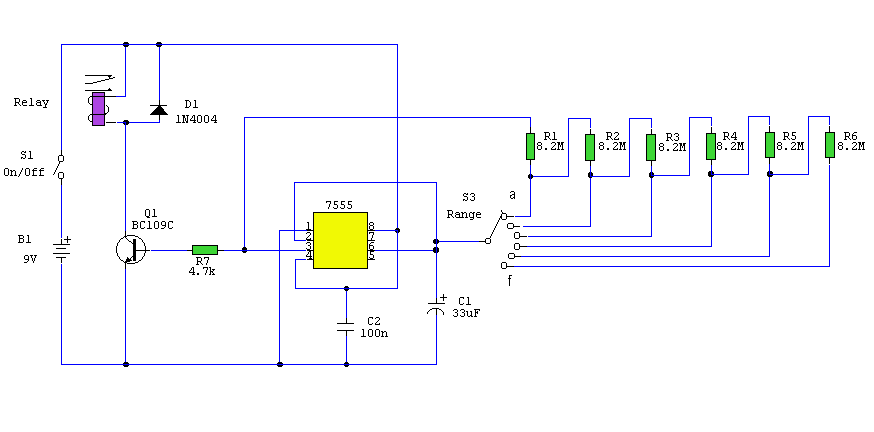
Notes:
This timing circuit mirrors the functionality of the 5 to 30 minute timer, with the crucial difference being that when switch S1 is activated, the circuit's switching behavior continues indefinitely until S1 is deactivated again. For optimal performance, a 7555 time and low leakage type capacitor must be utilized for C1. The six-way rotary switch S3 introduces variable resistance into the timing circuit, allowing for adjustment with each rotation, offering a minimum resistance point labeled “a” and a maximum point labeled “f”. The 7555 is configured as an equal mark/space ratio oscillator, and the timing resistor chain R1 through R6 is connected back to the timer’s output at pin 3. The output pulse duration is calculated as follows:-
T = 1.4 R1 C1
This results in on and off durations approximately 379 seconds at position “a” of S3 (approximately 6 minutes), and up to 38 minutes at position “f”. These durations can be modified by changing the values of R1 through R6 or C1.
Integrated Circuit Description
The 7555 is a versatile integrated circuit, frequently utilized as a timing device. It operates as a monostable multivibrator, meaning it produces a single pulse of a defined duration when triggered. Its primary function is to generate accurate timing signals, relying on its internal oscillator circuit. The 7555 is a bipolar junction transistor (BJT) IC, known for its robustness and ability to withstand various environmental conditions. It is commonly found in applications requiring precise timing control, such as timers, oscillators, and pulse generators. A key feature is its ability to be configured as an equal mark/space ratio oscillator, allowing for the creation of accurate timing circuits. Its output pin (pin 3) provides the pulse signal that drives the timing chain, ensuring precise control over the duration of the on and off states of the timer. The 7555’s low leakage capacitor requirement is crucial for maintaining circuit stability and accuracy over extended periods.
This gives on and off times of about 379 seconds for postion “a” of S3 (just over 6 minutes), to about 38 minutes at point “f”. The times may of coourse be varied by altering R1 to R6 or C1.
circuit from http://www.zen22142.zen.co.uk/