- Build Your Dynamic LED Rhythm Circuit
- Dark Activated LED Flasher: Bowes Circuit Design
- Build a Stunning Two LED Flashing Circuit with Potentiometers
- Electronic Dice: Build Your Own Random Number Generator!
- Build a Rotating Back Light: 555 Timer Circuit Diagram
- Flashing Lamps Circuit: 230V AC with SCR Timing
- Portable 230V AC Lamp Flasher Circuit Diagram
- Build Your 4017 Decade Counter – A Brilliant 9-Step Sequence
- Build Your Own Flashing Lamp Circuit – 10W LED Support
- Pulsating LED Circuit: Build Your 4s Cycle Effect
- High-Intensity LED Flasher Circuit Diagram – Build Your Own!
- Build a Reactive LED Circuit: Diagram & Parts List
- Pulse LED Circuit: Build a Dynamic Two-Strip Design
- 12 Stage Neon Sequencer: Circuit Diagram & Build Guide
- Flash Lamp Circuit: Build Your Own Flasher
High-Intensity LED Flasher Circuit Diagram – Build Your Own!
Circuit diagram:
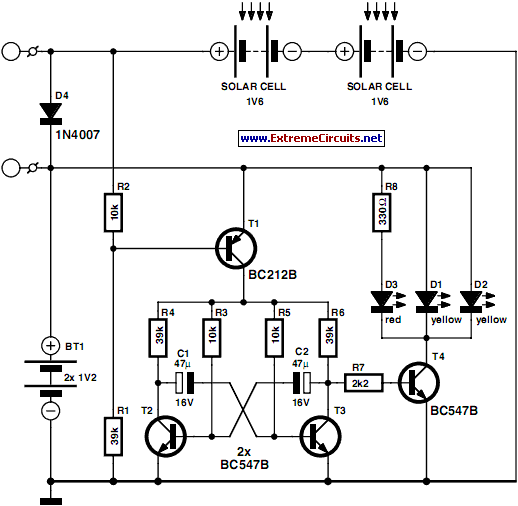
Description
This circuit has been created as a hazard indicator to notify other road users about potential dangers in low-visibility conditions. It can also function as a bicycle light, provided it adheres to all relevant traffic rules and legal requirements. White LEDs are advised when utilizing the circuit as a front light for a bicycle – specifically for illuminating the road ahead, while red LEDs are recommended for usage as a rear light. When sunlight is available, the two 1.6-V photovoltaic cells charge the two AA batteries. At night, the photovoltaic cell voltage vanishes, and the batteries automatically power the circuit. The flashing rate is approximately one pulse per second, and the LED illumination duration is approximately 330 ms.
The duty cycle is intended to ensure the batteries can sustain the circuit's operation throughout the night. The circuit comprises three distinct sections. Under standard daylight conditions, the batteries are replenished through diode D4. During darkness, the pnp transistor T1 is activated, delivering battery current to the second part, which is a low-frequency oscillator made up of transistors T2 and T3. The third part consists of the LED driver surrounding transistor T4, which activates and switches on LEDs D1-D2-D3 when the collector voltage of T3 increases.
More about components
Integrated circuits play a crucial role in this circuit's operation. Transistor T4 is a single-channel NPN transistor, a fundamental building block in electronics. It acts as a switch, controlling the flow of current to the LEDs. This component is commonly used in switching applications due to its small size, low cost, and relatively simple control. The BC547B is a general-purpose transistor that’s frequently used in amateur electronics projects because of its robustness and availability. For applications demanding higher power levels, a MOSFET transistor is a more suitable alternative to the BC547B. MOSFETs are voltage-controlled devices, offering superior switching characteristics and a wider current handling capability.
Furthermore, the operation of transistors T2 and T3 in the low-frequency oscillator is dependent on their integrated circuitry. These transistors are core components of the oscillator circuit, generating the rhythmic flashing pattern. These integrated circuits are essential for creating the consistent pulsating action of the hazard warning circuit.
Two LEDs (D1, D2) are high-brightness yellow types, with a luminous intensity ranging from 20,000 to 30,000 mcd, and one (D3) is a standard 3-mm red LED used for control purposes. It’s possible to augment the number of LEDs to achieve higher illumination levels; however, limitations exist regarding the maximum collector current that transistor T4 can handle. For high-power applications, a MOSFET transistor is suggested instead of the common BC547B.
circuit from http://www.extremecircuits.net/2010/05/high-intensity-led-warning-flasher.html