similar circuits
- Build Your Dynamic LED Rhythm Circuit
- Dark Activated LED Flasher: Bowes Circuit Design
- Build a Stunning Two LED Flashing Circuit with Potentiometers
- Electronic Dice: Build Your Own Random Number Generator!
- Build a Rotating Back Light: 555 Timer Circuit Diagram
- Flashing Lamps Circuit: 230V AC with SCR Timing
- Portable 230V AC Lamp Flasher Circuit Diagram
- Build Your 4017 Decade Counter – A Brilliant 9-Step Sequence
- Build Your Own Flashing Lamp Circuit – 10W LED Support
- Pulsating LED Circuit: Build Your 4s Cycle Effect
- High-Intensity LED Flasher Circuit Diagram – Build Your Own!
- Build a Reactive LED Circuit: Diagram & Parts List
- Pulse LED Circuit: Build a Dynamic Two-Strip Design
- 12 Stage Neon Sequencer: Circuit Diagram & Build Guide
- Flash Lamp Circuit: Build Your Own Flasher
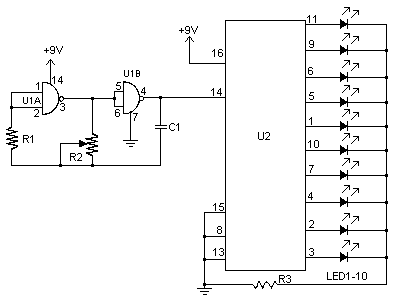
Build Your Own 10 LED Chaser Circuit
Description
It’s perplexing why individuals are drawn to flickering illumination. Numerous LED sequences are prevalent, found in television programs (like *Knight Rider*), films, and retail displays. This schematic represents my interpretation of a straightforward 10 LED sequence. A 555 timer hasn’t been incorporated due to their substantial cost – approximately $4 Cdn – at my local electronics supplier. Instead, an oscillating circuit constructed from two sections of a 4011 CMOS NAND gate is implemented. This integrated circuit is remarkably affordable and exceptionally common.4011 CMOS NAND Gate
The 4011 is a versatile digital logic integrated circuit, frequently utilized in various applications due to its relatively low cost and readily available documentation. This chip operates using CMOS (Complementary Metal-Oxide-Semiconductor) technology, which is known for its low power consumption and high input impedance. It contains four independent NAND gates, each of which performs a basic logical operation, enabling the creation of complex digital circuits. The 4011 is easily sourced and compatible with a wide range of power supplies, making it a popular choice for hobbyists and engineers.Circuit diagram
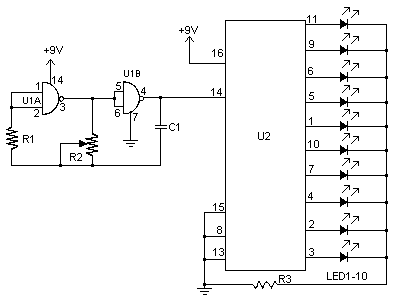
Parts:
- R1 1 Meg 1/4W Resistor
- R2 100K Pot
- R3 1K 1/4W Resistor or 220Ohm if using blue LEDs
- C1 0.1uF 16V Ceramic Disk Capacitor
- U1 4011 CMOS NAND Gate
- U2 4017 CMOS Counter
- LED1-10 LEDs Of Any Colour
- MISC Board, Sockets For ICs, Knob For R2
Notes:
- Adjust the "chase rate" using R2.
- A lower value resistor may be necessary when using blue LEDs; try 220Ohm.
- Incandescent lamps can be substituted for LEDs. Transistors should be used to drive them; connect the base of the transistors to each of the outputs of the 4017 through a 1K resistor. Connect one end of the lamp to the positive supply, and the other end to the collector of the transistor. The emitter then goes to ground. Heat sinks may be required for larger power transistors.
- Increasing the value of C1 will slow down the "chase rate".
- If unusual circuit behavior is observed, replace R1 with a 33K resistor, and increase C1 to 1uF.
- When using this circuit in a vehicle, it's essential to note that flashing red, blue, or yellow lights are restricted in some areas unless employed by emergency vehicles.
circuit from http://www.aaroncake.net/